COMMUNICATION
Torre delle Arti, Bellagio — 2016
To communicate is to choose.
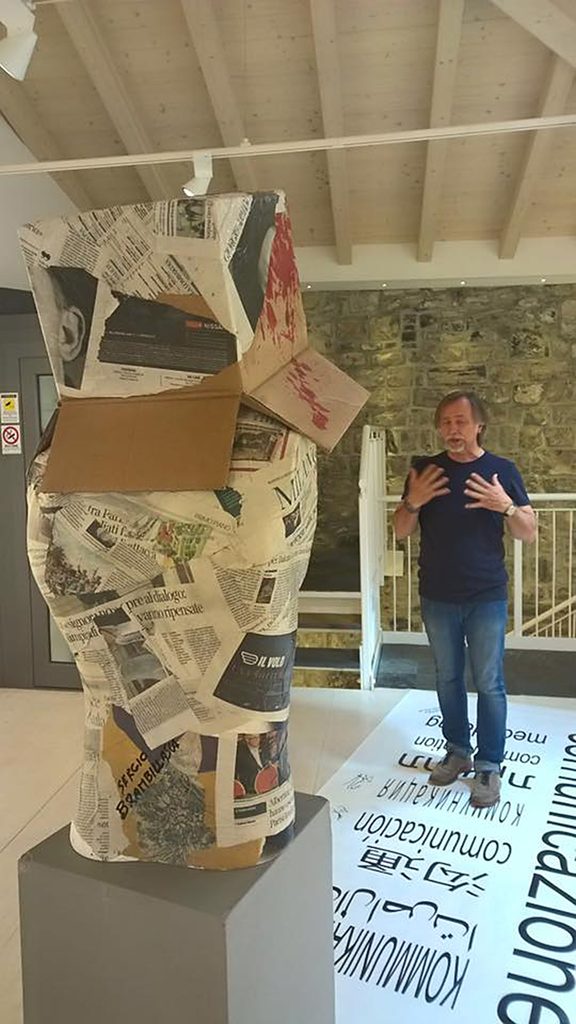
We are constantly surrounded by words, images and information. They reach us, overlap and sometimes contradict one another, inevitably influencing the choices we make.
The mannequin covered in newspapers, with its head enclosed in a cardboard box, represents the individual immersed in this flow: a person bombarded by communication and called upon to recognize, among many possible directions, the one they believe to be right.
THE JOURNEY
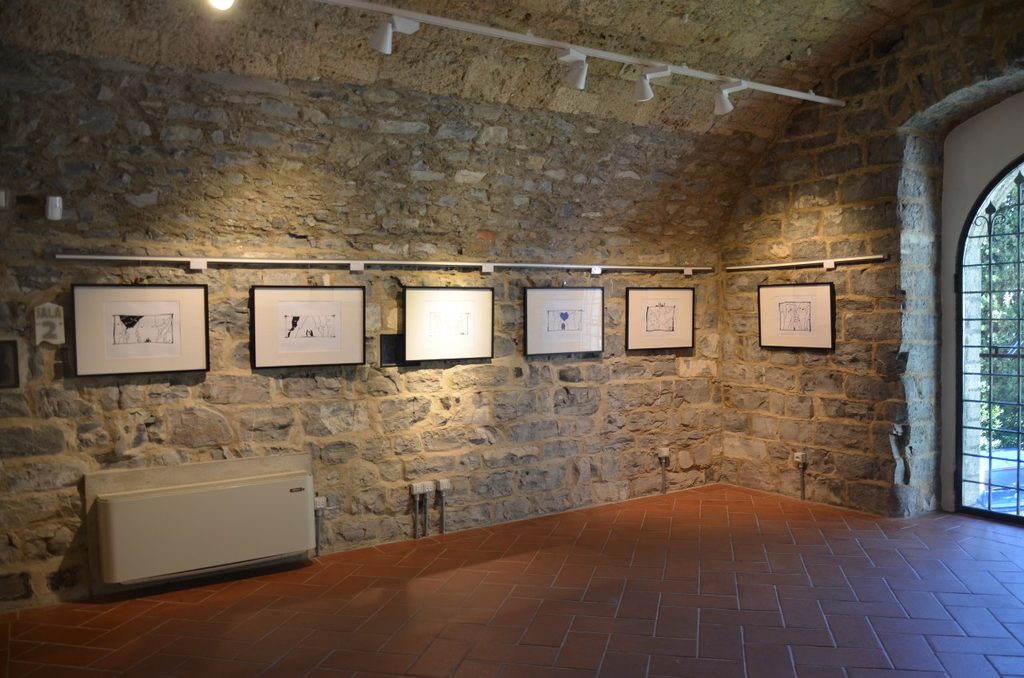
The artworks are not conceived as isolated images, but as stages of a single journey.
Profiles, theatre and inner rooms guide the visitor towards a more intimate space, where communication received from the outside encounters the communication that arises within us.
Observing thus becomes a way of listening to what remains in our own mind.
THE ACT OF PARTICIPATING
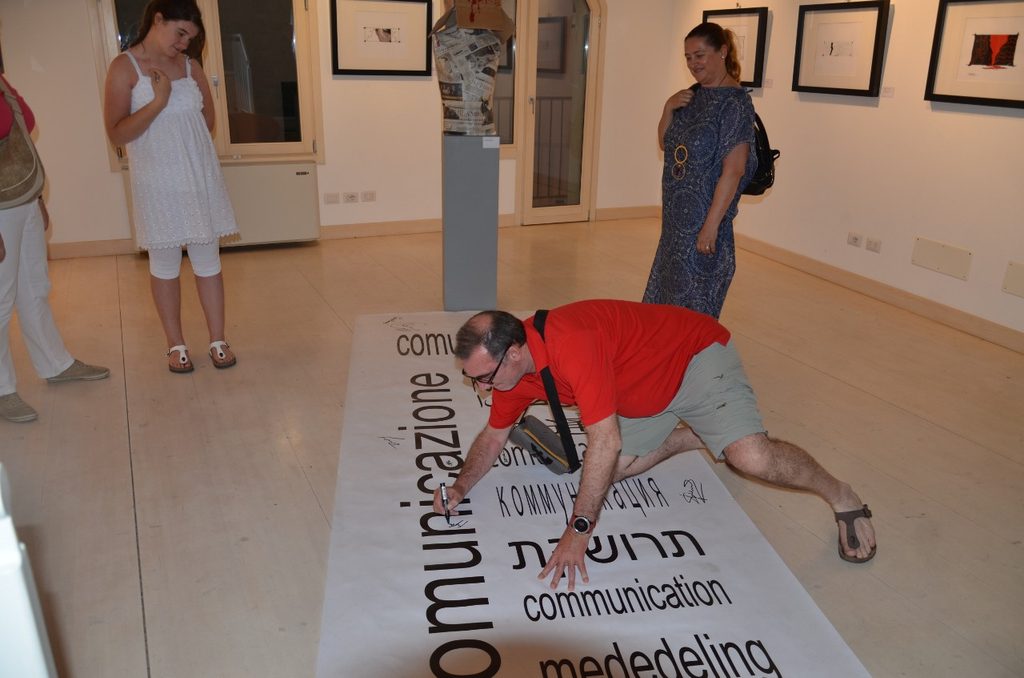
The signature is the gesture that completes each visitor’s individual journey.
After moving through the exhibition, observing the artworks and reflecting on what remains in their mind, each person is invited to leave their mark.
Not simply a signature of presence, but a conscious choice to become part of the artwork.
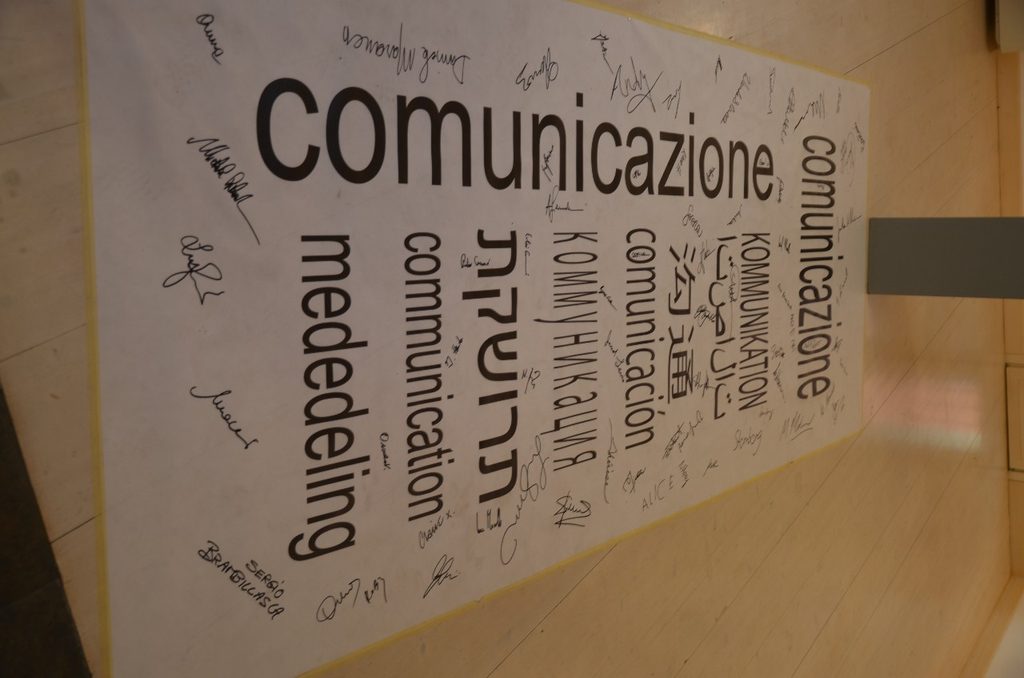
The artwork is complete when the viewer chooses to become part of it.
MEDITERRANEO
Sergio Brambillasca and Paolo Levi — Cremona, 2018
When the visual mark meets the written word.
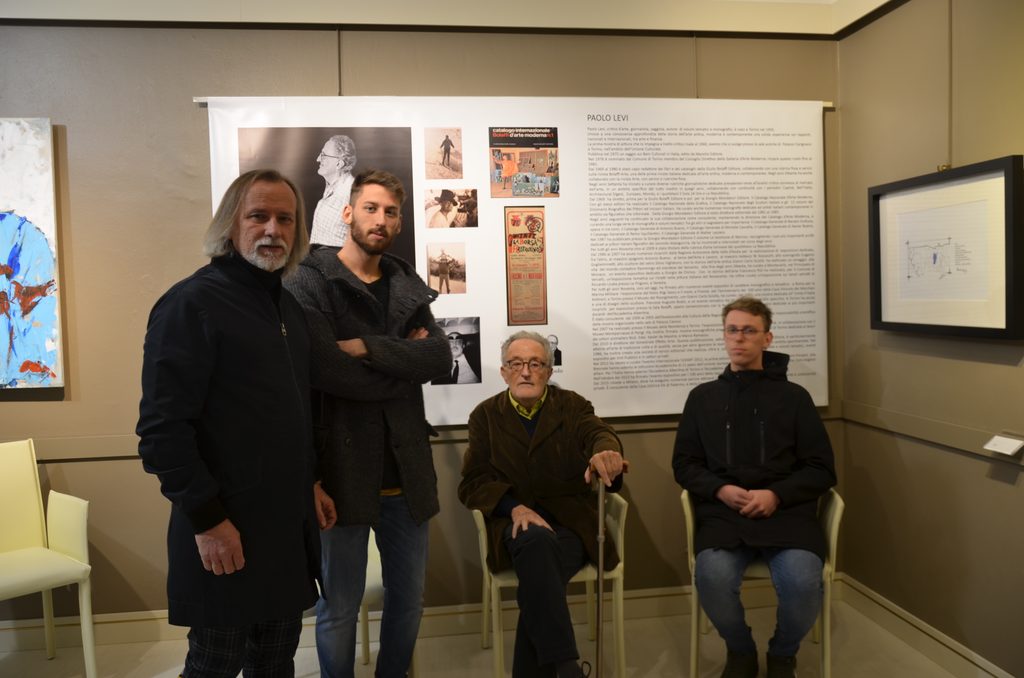
MEDITERRANEO was born from the encounter between two artistic languages and two generations.
Sergio Brambillasca’s essential visual language meets the poetry of Paolo Levi. Drawing and poetry come together, giving life to 21 compositions dedicated to the Mediterranean and to the lives lost in its waters.
Two different forms of expression share the same responsibility: to preserve memory and resist indifference.
THE SECOND HOLOCAUST
In 2018, Mediterraneo used the expression “Second Holocaust” to describe the tragedy of people losing their lives while attempting to cross the Mediterranean and reach Europe.
A deliberately powerful expression, born from the need to challenge desensitization and indifference in the face of the loss of human life.
THE TESTIMONY
The television report produced in Cremona in 2018 documents the Mediterraneo project and the meaning attributed at the time to the expression “Second Holocaust”.
PRESS COVERAGE
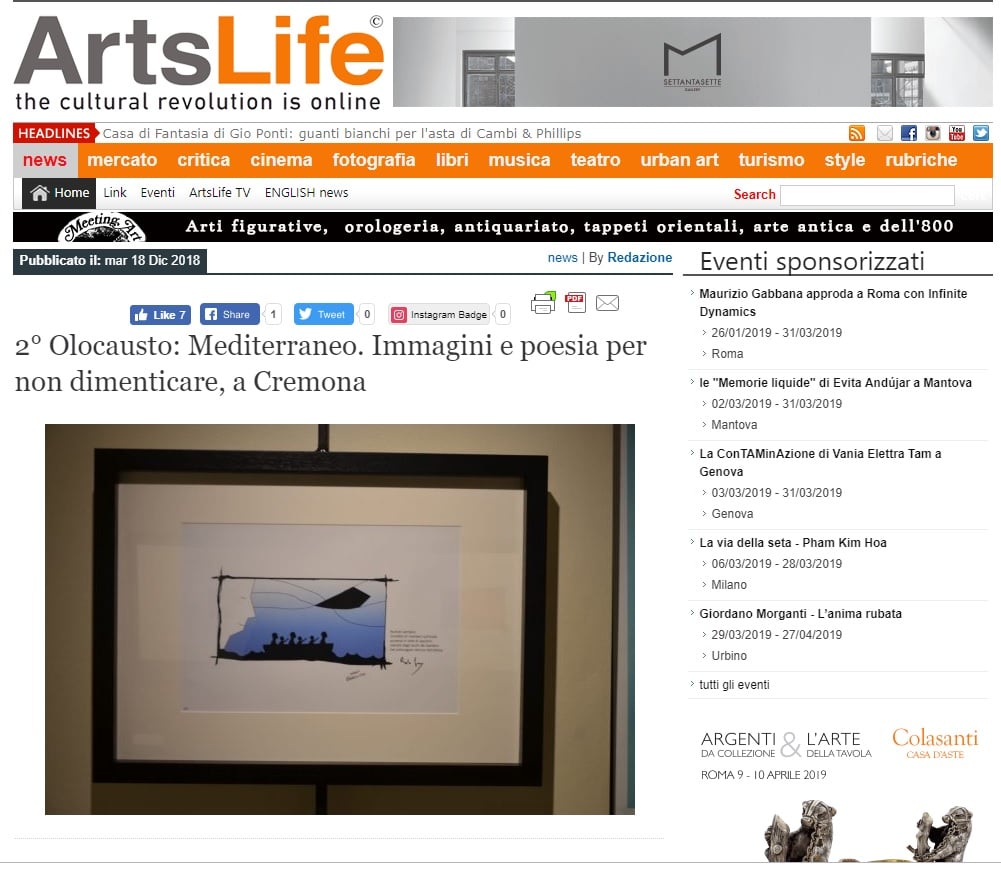
In 2018, ArtsLife also documented the project in an article entitled “2° Olocausto: Mediterraneo. Immagini e poesia per non dimenticare, a Cremona” (“Second Holocaust: Mediterraneo. Images and Poetry to Remember, in Cremona”).
THE VISUAL MARK AND THE WORD
The dialogue between Sergio Brambillasca and Paolo Levi takes shape directly on the artwork: the visual mark meets the written word, and two artistic languages become a single testimony.
FROM CREATION TO EXHIBITION
The dialogue between visual art and poetry, born from the encounter between two artists, develops into an exhibition journey.
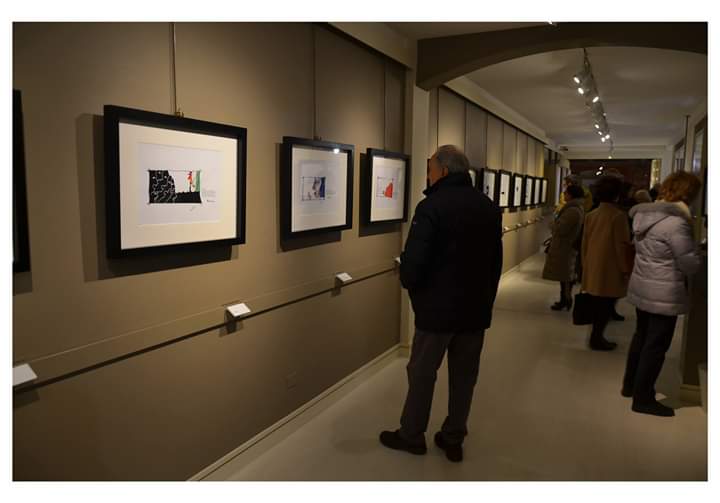
The 21 compositions of Mediterraneo leave the space of creation to encounter the gaze of the public.
The artwork does not merely recount a tragedy: it invites viewers to reflect on memory, responsibility and the value of every human life.
PASSING ON MEMORY
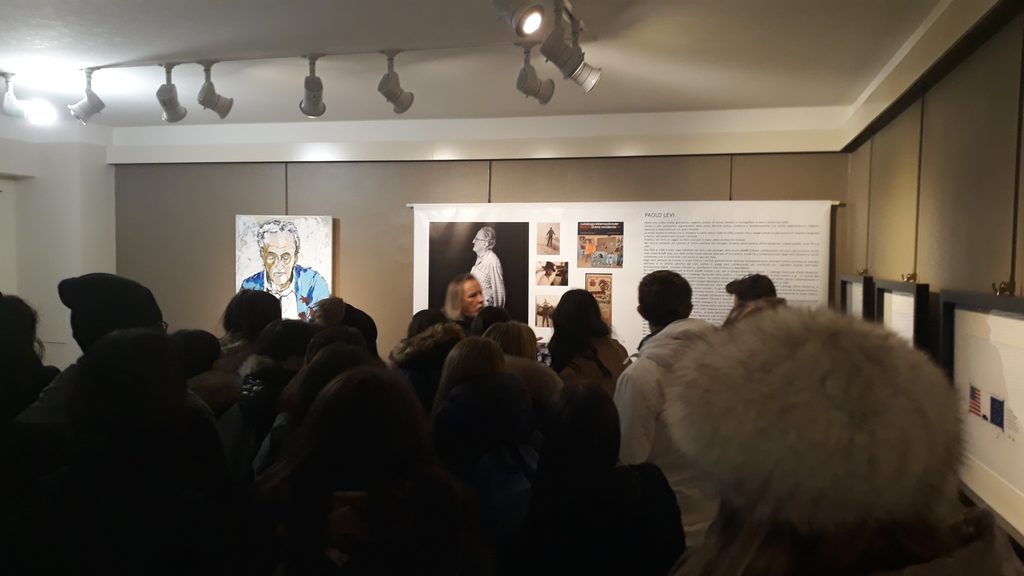
The exhibition also becomes a place of encounter with younger generations. Students’ visits transform memory into a responsibility to be passed on: understanding what is happening also means choosing not to remain indifferent.
MARILYN — FROM ART TO SWISS WATCHMAKING
Arcadia Art Gallery — Milan, Navigli, 30 October 2021
“A Lei — From Art to Swiss Watchmaking.” The presentation on 30 October 2021 featured projections of Sergio Brambillasca’s works onto the façade of Arcadia Art Gallery and introduced the collaboration with Bereve. The event poster announced an address by art critic Federico Caloi and named L’Orologio as media partner.

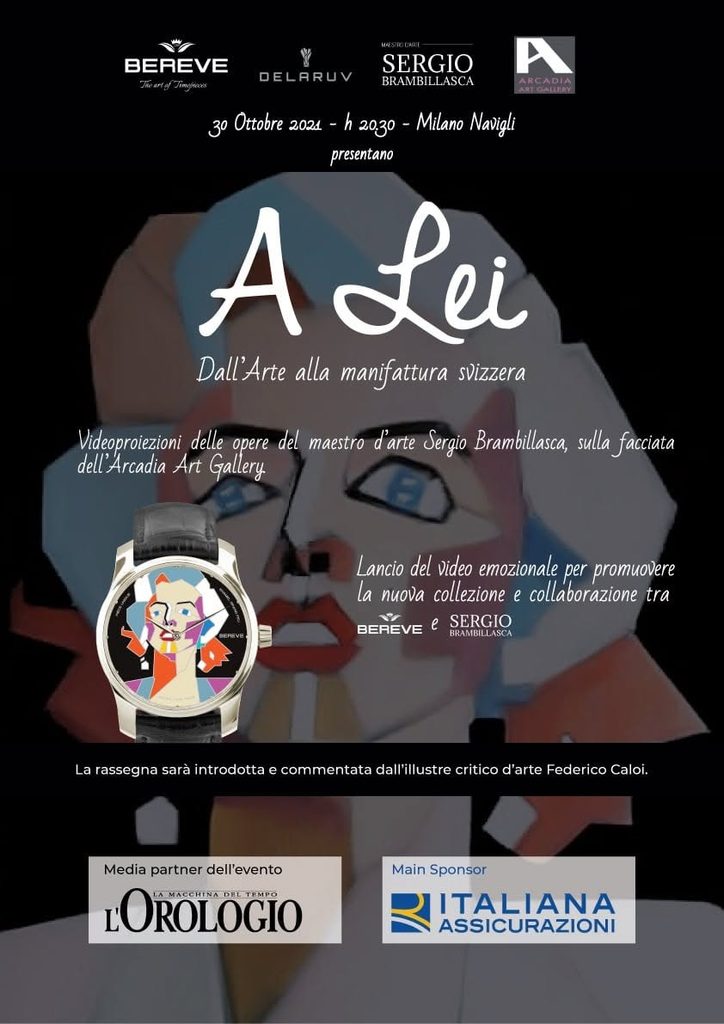
A work of art can move beyond the canvas, cross different artistic languages and take on new forms without losing its identity.
This idea lies at the heart of the encounter between Sergio Brambillasca’s artistic research and Swiss watchmaker Bereve.
Marilyn becomes the centre of a journey that brings painting, time and exhibition space into dialogue.
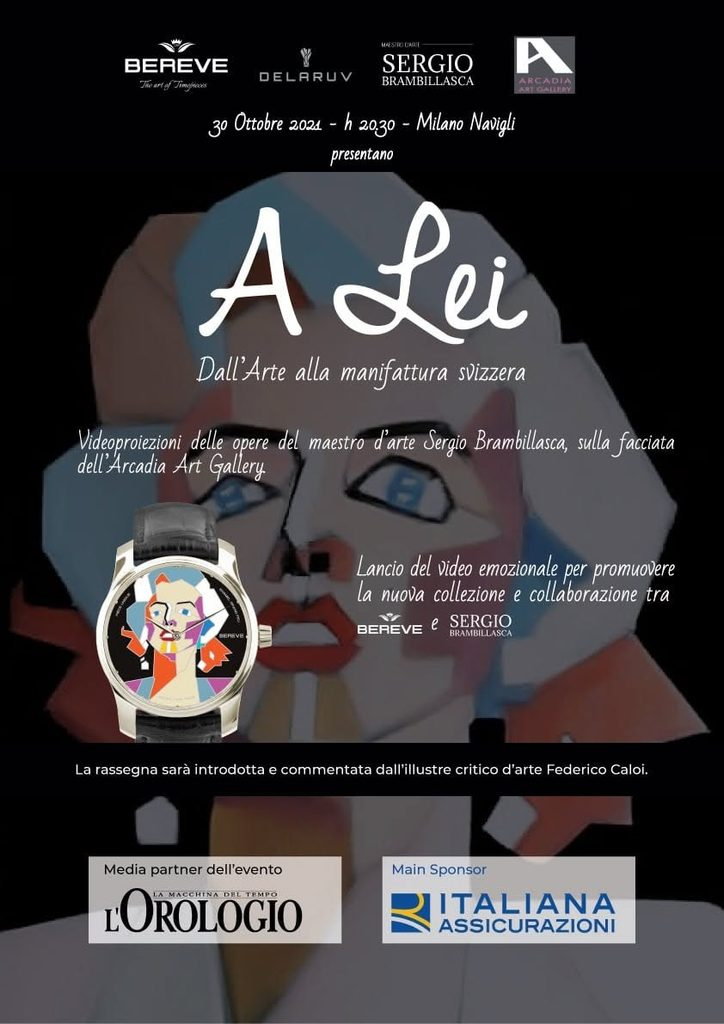
THE ARTWORK MEETS THE CITY
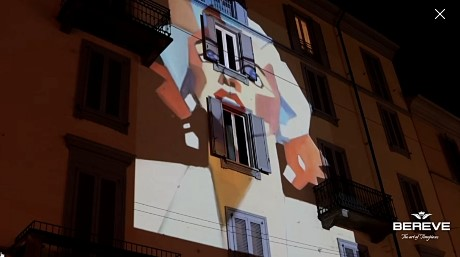
On 30 October 2021, at Arcadia Art Gallery in Milan, Marilyn moves beyond the boundaries of the canvas and is projected onto the gallery’s façade, transforming architecture into an exhibition space and the city into a spectator.
The evening, accompanied by a presentation by art critic Federico Caloi, also marks the encounter between Sergio Brambillasca’s artistic language and Swiss watchmaker Bereve: the artwork no longer merely represents time — it becomes part of time itself.
WHEN ART BECOMES TIME
Marilyn crosses a new boundary: from the canvas to the dial of a Swiss watch.
Through the collaboration with Bereve, Sergio Brambillasca’s artistic language preserves its identity while taking on a new function and dimension.
Time is no longer merely what a watch measures: it becomes the space in which the artwork continues to live.
ART, CINEMA AND PHOTOGRAPHY — A MEETING OF ARTISTIC LANGUAGES
The presentation of Marilyn, held on 30 October 2021 at Arcadia Art Gallery in Milan, becomes a meeting point for painting, photography, cinema and Swiss watchmaking.
The promotional film, directed by Grazia Lissi, an Italian photographer and journalist, visually interprets the artwork’s journey from canvas to the dial of a Bereve watch, transforming the collaboration into a visual narrative.
The evening is also attended by Giuseppe Caleffi, President of the Antonio Ligabue House Museum in Gualtieri, alongside several cast members of the film Hidden Away (Volevo nascondermi), which tells the story of the artist Antonio Ligabue, portrayed by Elio Germano.
The presence of figures from different cultural fields accompanies a project in which the artwork is no longer confined to its original form, but moves across new artistic languages, places and dimensions.
Marilyn is not simply reproduced on an object: it continues its artistic journey, entering into a dialogue with time, images and people.
IN THE FOOTSTEPS OF VIOLENCE — THE JOURNEY OF MEMORY
WHERE THE JOURNEY BEGINS
In the Footsteps of Violence was born from Sergio Brambillasca’s artistic research and his determination to address, through his own visual language, some of the deepest wounds of contemporary society.
The project takes shape through fourteen artworks, conceived as fourteen stations along a journey inspired by the structure of the Stations of the Cross. This is not a religious representation, but a journey through real events in which violence has profoundly marked the lives of individuals and their families.
The artistic conception, creation of the artworks, expressive language and design of the exhibitions are entirely the work of Sergio Brambillasca.
UNAVI — the National Victims’ Union, chaired by Paola Radaelli — contributed to the travelling exhibition by identifying the locations in which the collection would be presented.
The fourteen artworks were created before the texts that accompany them. Only afterwards were writers, actors, journalists and other public figures invited to engage with the images and compose verses and reflections.
It was not the words, therefore, that gave rise to the artworks. It was the artworks that gave rise to new words.
THE LANGUAGE OF THE ARTWORK
Sergio Brambillasca’s artistic language extends beyond the representation of figures.
The perimeter, the profiles, the empty spaces and the marks crossing the composition construct a place in which reality is transformed into an artistic experience.
The perimeter is not merely a graphic boundary. It defines a space, a theatre in which an event unfolds, while also suggesting what remains outside the representation.
The profiles evoke human presences, but they can take on different meanings: observers, witnesses, responsibility, absence or expressions of pain.
Their position, orientation and relationship with the other elements of the artwork help determine their meaning.
Empty space also plays a part in the composition. It can become the place of loss, waiting and memory.
In this language, the artwork does not necessarily offer an answer. It constructs a question addressed to the viewer.
This is where In the Footsteps of Violence goes beyond the act of denunciation: it does not merely recall events that have occurred, but invites reflection on individual and collective responsibility.
THE EYES OF DEATH
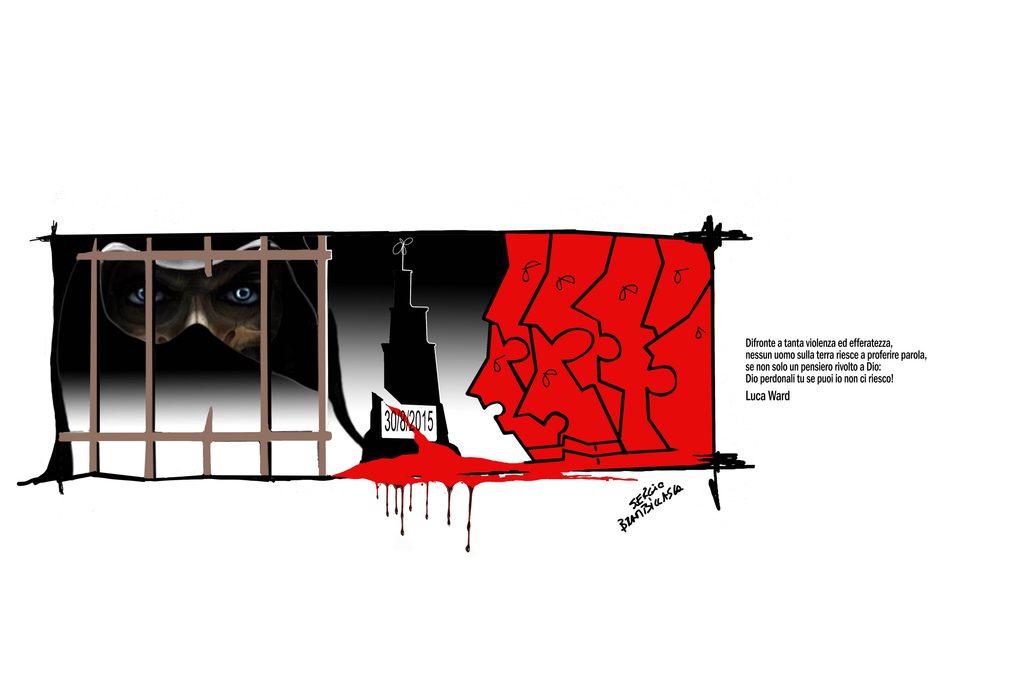
During the preparation of In the Footsteps of Violence, Sergio Brambillasca experienced one of the most emotionally difficult moments of his artistic journey.
While working on the artwork dedicated to the murder of Rosita Solano’s parents, the artist wanted to represent the eyes of death.
Death took on the appearance of the murderer who, crossing the town, was on his way to commit a brutal and savage killing.
Brambillasca began with those very eyes.
During the night, while working in his studio, the gaze taking shape before him provoked such intense fear that he felt compelled to close the windows.
It was not simply the distress caused by knowing about a tragedy. It was a confrontation with the image of death that he himself was bringing into existence through his artistic language.
The experience affected him so deeply that he considered abandoning the entire project of fourteen artworks.
He spoke about it with Paola Radaelli, president of UNAVI, who encouraged him to continue and complete the exhibition.
Brambillasca decided to carry on.
This episode reveals how deeply the creation of In the Footsteps of Violence involved the artist, not only on an expressive level but also on a human one.
The artwork did not arise from a desire to illustrate a news event, but from an attempt to transform the presence of death into an image capable of questioning those who observe it.
WHEN THE IMAGE PRECEDES KNOWLEDGE
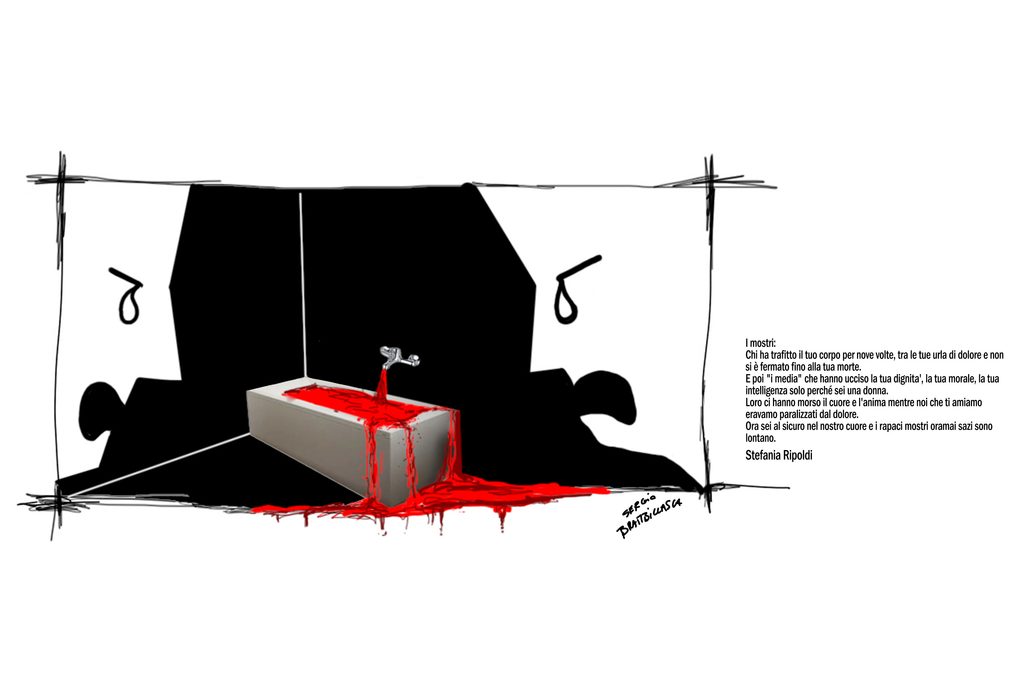
Another significant experience concerns an artwork that Brambillasca initially struggled to conceive.
For days, he searched for an image capable of representing the event, without finding a solution that convinced him.
One morning, after washing, he placed a towel on the bathtub.
At that very moment, a precise image appeared in his mind: a bathtub overflowing with blood.
He immediately went to work on the artwork.
Only much later did he learn a detail of the actual event: the victim had been taken into the bathroom and killed there.
Brambillasca remembers this episode as one of the most surprising moments of his artistic experience.
The account does not claim to explain that coincidence. Rather, it bears witness to a creative process in which knowledge, memory and intuition can intertwine in unexpected ways.
For the artist, technique is the instrument through which an image takes shape. The artwork is what emerges from that process, together with the thought and meaning it contains.
TELL MY PARENTS I LOVE THEM — LOVE IS STRONGER THAN VIOLENCE
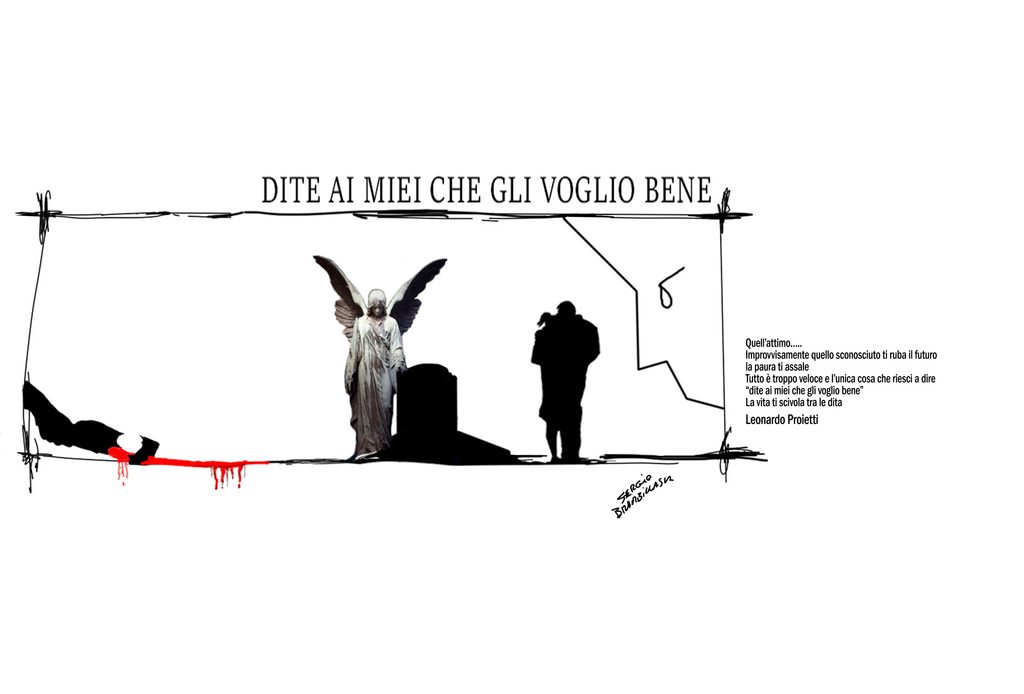
A young man is standing outside a bar, talking with his friends.
Shortly before, inside the bar, a man has argued with the bartender. After leaving the premises, he takes a bottle, breaks it and attacks the first young man he encounters, inflicting a fatal wound to his throat.
His friends try to help him.
The young man realises that his life is coming to an end. At that moment, his thoughts are not directed towards his attacker, nor towards the violence he has just suffered.
He thinks of his parents.
“Tell my parents I love them.”
These are the words that become the centre of Sergio Brambillasca’s artwork.
The artist chooses not to depict the murderer. On the left-hand side of the perimeter, only a hand appears, gripping the broken, bloodstained bottle.
For Brambillasca, the perpetrator of that violence is not worthy of being represented within the theatre of the artwork.
At the centre of the composition, in front of a gravestone, two figures hold one another: they are the young man’s parents, united in a grief from which they cannot escape.
Beside them stands an angel.
But that angel is not a presence unrelated to the event. It is the son himself, whom the artist has chosen to portray in the form of an angel.
His position creates a symbolic separation between the brutality of the act and the love that survives death.
Within the theatre of the artwork, there is no place for the murderer. It belongs to the son and his parents.
On the right-hand side, the perimeter becomes a human profile from which a tear falls.
That profile represents Sergio Brambillasca.
It is the artist entering his own work, deeply affected by the event and by the power of the young man’s final words.
Brambillasca, himself a father, recalls the suffering he experienced while creating the artwork, imagining the pain of the parents as they received their son’s final message of love from his friends.
The sentence runs across the upper part of the composition, rising above every other element.
Violence is confined to a hand, a bottle and a trace of blood.
Love, by contrast, occupies the centre and embodies the meaning of the artwork.
Violence was able to take the young man’s life, but it could not erase his love for his parents.
In Brambillasca’s theatre, love triumphs over violence.
Poetic text by Leonardo Proietti.
THE MAN AND THE WHEELCHAIR — A LIFE CHANGED BY VIOLENCE
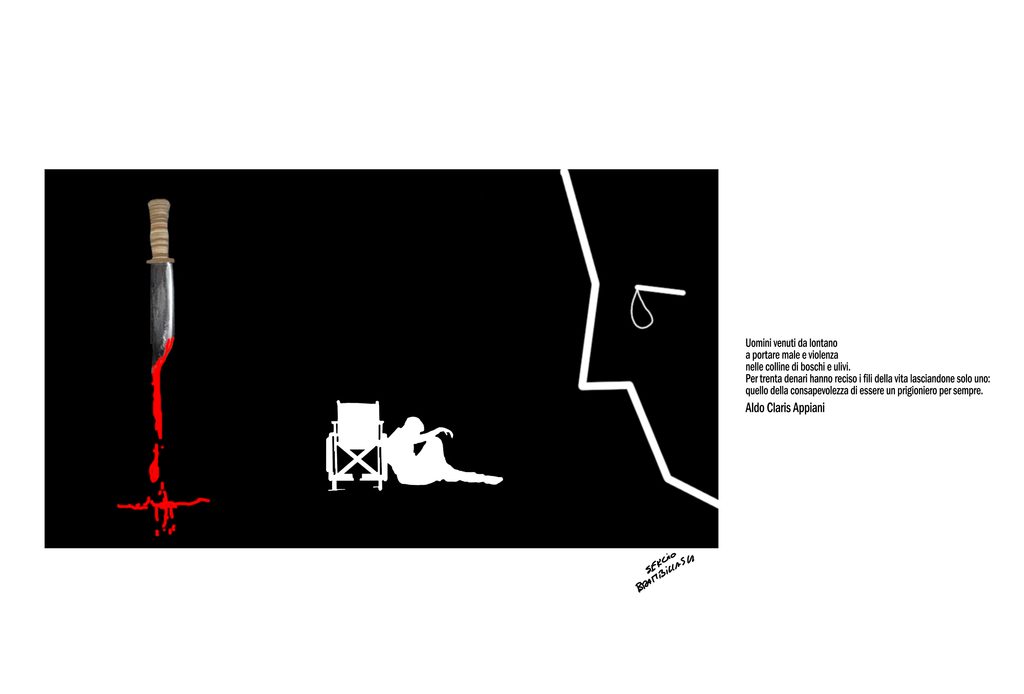
A knife attack changes a man’s life forever.
The victim survives, but his injuries leave him paraplegic, making it necessary for him to use a wheelchair to move around.
Sergio Brambillasca constructs the artwork around a few elements, immersed in an entirely black space.
On the left, a bloodstained knife represents the violence that caused the tragedy. Blood runs down the blade and gathers on the ground.
At the centre, a white human figure lies beside a wheelchair.
It is the injured man, immersed in his own suffering.
Brambillasca has chosen to represent the man and the wheelchair separately, yet close to one another, because from that moment onwards they will become inseparable.
The wheelchair is not merely an object within the composition. It is the instrument that will accompany the man throughout his life, making his movement possible.
On the right-hand side appears a profile marked by a tear, a recurring element in the artist’s language.
The meaning of the artwork also emerges from the explanation Brambillasca gives to students during his visits to schools.
The artist invites them to reflect on the loving relationship between two people.
Throughout life, we may meet someone with whom we decide to share our journey. Someone with whom we can talk, exchange ideas, grow and build a future together.
It is a relationship born from the freedom to choose and to imagine a shared future.
In the artwork, however, the man faces a bond he did not choose: his relationship with an instrument that has become indispensable because of the violence he suffered.
This comparison does not deny the possibility of loving or being loved after a permanent injury. It highlights the difference between a freely chosen relationship and a condition imposed by an act of violence.
The man and the wheelchair thus become two inseparable presences. Within the theatre of the artwork, their bond represents a condition imposed by violence, in contrast with the human relationships that everyone should be free to choose.
The bloodstained knife represents an act committed in a matter of moments.
The man and the wheelchair represent consequences destined to last throughout his life.
It is through this contrast that Sergio Brambillasca constructs the meaning of the artwork: an act of violence may last only an instant, yet irreversibly transform a person’s future.
Poetic text by Aldo Claris Appiani.
PALAZZO PIRELLI — THE BEGINNING OF THE JOURNEY
2022 — Premio Mede@
In 2022, Sergio Brambillasca received the Premio Mede@. The award plaque recognizes his “continued efforts in the fight against gender-based violence and violence in general” (translated from the original Italian). The recognition documents the artist’s commitment to addressing violence, a theme also explored in In the Footsteps of Violence.
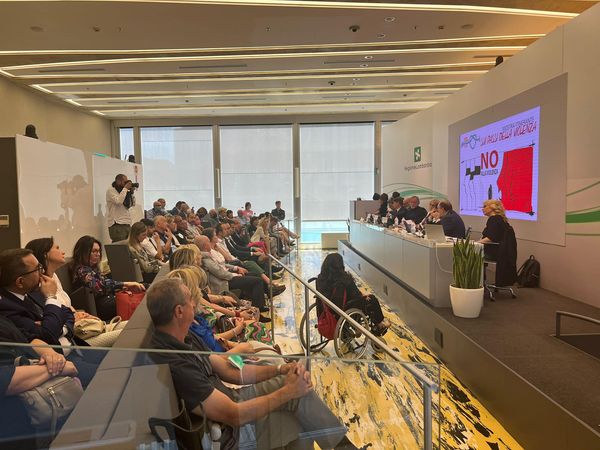
In May 2022, In the Footsteps of Violence was presented for the first time at Palazzo Pirelli in Milan.
It was the collection’s first public exhibition and the beginning of its journey through different locations.
The fourteen artworks form a unified whole. Each station possesses its own identity, but acquires further meaning through its relationship with the others.
The exhibition design is an integral part of the artist’s research: not merely the arrangement of the artworks, but the creation of a journey in which visitors are invited to observe, pause and reflect.
During this first exhibition, an encounter took place that Brambillasca remembers with particular emotion.
Michele Ruffini’s mother approached the artist, embraced him and said:
“Thank you, Sergio, for creating this exhibition, because people will remember my son.”
Those words capture one of the project’s deepest meanings.
The exhibition cannot change what happened, but it can help keep alive the memory of the people behind the stories of violence.
In that embrace, memory ceased to be merely the subject of an artwork and became a human responsibility.
PAVIA — WHEN AN ARTWORK ENCOUNTERS A PERSON
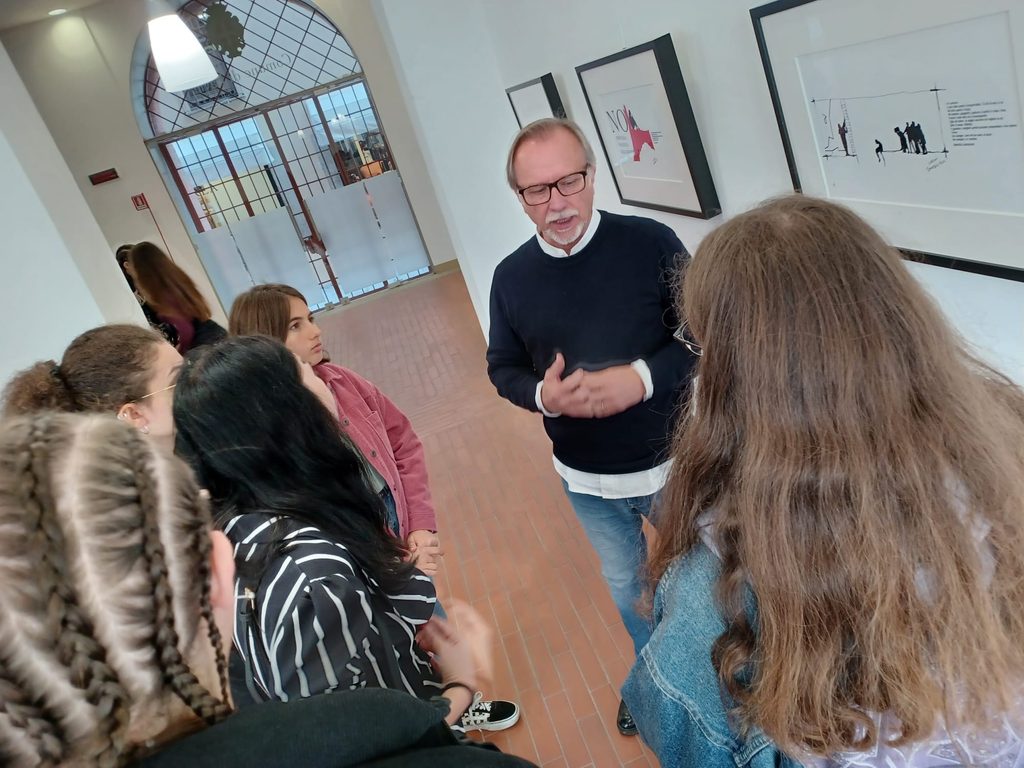
In October 2022, the exhibition arrived at the Broletto in Pavia.
During a school visit, Sergio Brambillasca guided a group of students through the fourteen artworks, explaining the events behind them and their meaning.
In the second room, in front of the artwork dedicated to bullying, a female student began to cry.
Her teacher approached her, embraced her and became emotional as well.
The artist witnessed the scene.
He did not know the personal reasons behind that reaction and did not attempt to assign it a meaning he could not know.
He understood, however, that the artwork had brought about a genuine encounter between what he had represented and the person observing it.
At that moment, art had awakened emotion, closeness and the willingness to listen.
MAGENTA — IN THE FOOTSTEPS OF BRAMBILLASCA
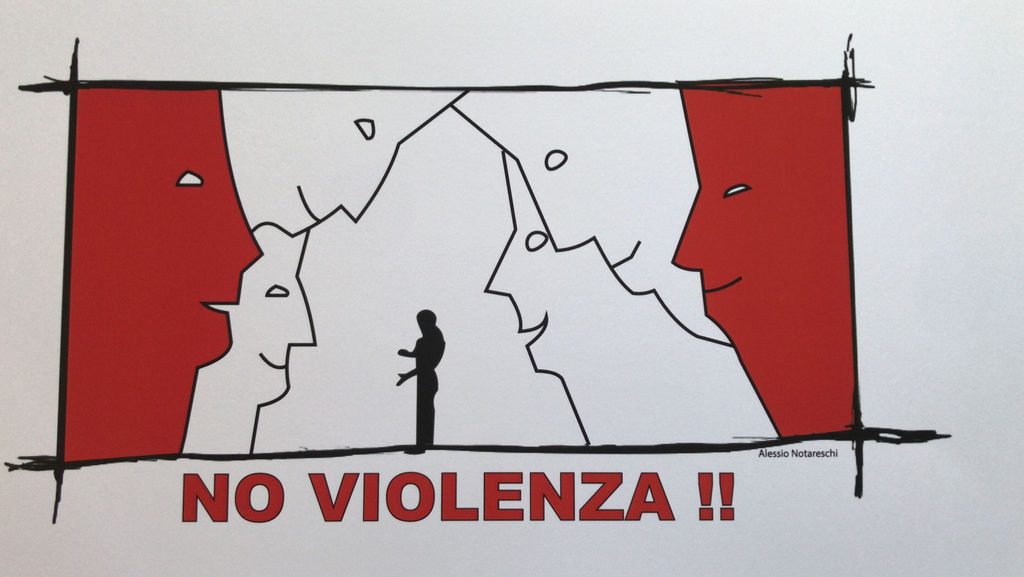
Another significant experience took place in Magenta.
After visiting In the Footsteps of Violence, a group of students created nine artistic works inspired by Sergio Brambillasca’s artworks and artistic language.
The works were subsequently sent to the artist with a title already attached:
“In the Footsteps of Brambillasca.”
Their creations contain recognisable elements of the artist’s research: the perimeter, the profiles, the presence of human figures and the relationship between space and mark-making.
These elements are reinterpreted through the students’ own sensibilities, giving rise to images and messages against violence.
The students did not merely observe the artworks.
They absorbed their language and used it to express their own thoughts.
The experience demonstrates how an artistic project can generate new forms of expression through the people who encounter it, without altering the authorship of the original artworks.
PORTOFERRAIO — REMEMBERING LORENZO CLARIS APPIANI
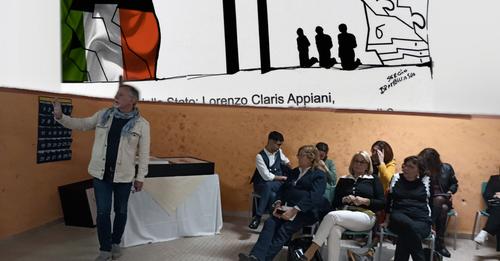
In May 2023, In the Footsteps of Violence reached Portoferraio, on the island of Elba.
At the Istituto Foresi, Sergio Brambillasca met students and explained the meaning of the fourteen artworks.
On this occasion, he also created a commemorative plaque bearing words he had written himself, dedicated to the memory of Lorenzo Claris Appiani, the lawyer killed in the shooting at the Palace of Justice in Milan on 9 April 2015.
The plaque was placed in the classroom dedicated to Lorenzo.
It was a gesture connecting two seemingly distant worlds: that of the school, looking towards the future, and that of a tragedy belonging to the past.
Through that presence, the memory of Lorenzo was also entrusted to the younger generation.
AN ARTWORK ON A JOURNEY
Following its first presentation at Palazzo Pirelli, In the Footsteps of Violence continued its journey through numerous Italian towns and cities.
Among other places, the collection reached Celle Ligure, Forte dei Marmi, Pavia, Rho, Vedano al Lambro, Magenta, Ferrara, Palazzolo sull’Oglio, Portoferraio, Chioggia, Lissone, Carpaneto Piacentino, Nerviano and Landriano.
The project was also presented in institutional venues, including the Senate of the Italian Republic and Palazzo Lombardia.
During these events, Brambillasca met representatives of institutions, victims’ families, teachers, students and members of the public.
Each place added a new experience to the journey.
The fourteen artworks remained unchanged, but the people observing them brought different questions, memories and reactions.
The collection retained its artistic unity, while the journey continued to be enriched by human testimonies.
ALBERTA CLARIS APPIANI — THE WISH TO BRING MEMORY INTO THE COURTHOUSE
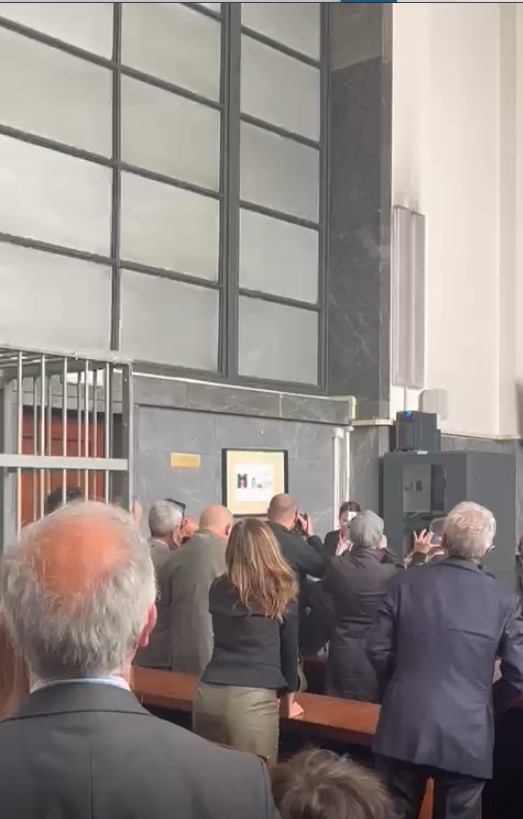
One of the most significant stages of the journey concerns the Palace of Justice in Milan.
For some time, Alberta Claris Appiani, Lorenzo Claris Appiani’s mother and a lawyer herself, had wished to bring In the Footsteps of Violence inside the courthouse.
It was Alberta herself who contacted Sergio Brambillasca.
Her wish also arose from the determination to keep alive the memory of her son, who had been killed in that very building in 2015.
For Alberta, bringing the exhibition to that place meant returning a testimony of remembrance to it.
It was not merely another exhibition.
It was an attempt to prevent Lorenzo’s name, together with those of the other victims, from gradually being forgotten.
The initiative reflected the meaning of Brambillasca’s project, in which remembering people is an essential part of the artistic work.
THE PALACE OF JUSTICE IN MILAN — DECEMBER 2025
Magistrate Ilio Mannucci Pacini played an important role in the process that led to the exhibition at the Palace of Justice.
His contacts with Sergio Brambillasca helped make it possible to exhibit the collection inside the courthouse.
In December 2025, In the Footsteps of Violence was presented at the Palace of Justice in Milan.
Sergio Brambillasca personally designed and installed the exhibition together with his sons, Simone and Gabriele.
The fourteen artworks thus entered a place where the subject of justice is not abstract, but belongs to the institution’s own history.
The artistic journey, born from reflection on violence and memory, encountered the place where one of the tragedies it recounts had actually taken place.
THE CANVAS OF MEMORY — WHEN THE PUBLIC ENTERS THE ARTWORK
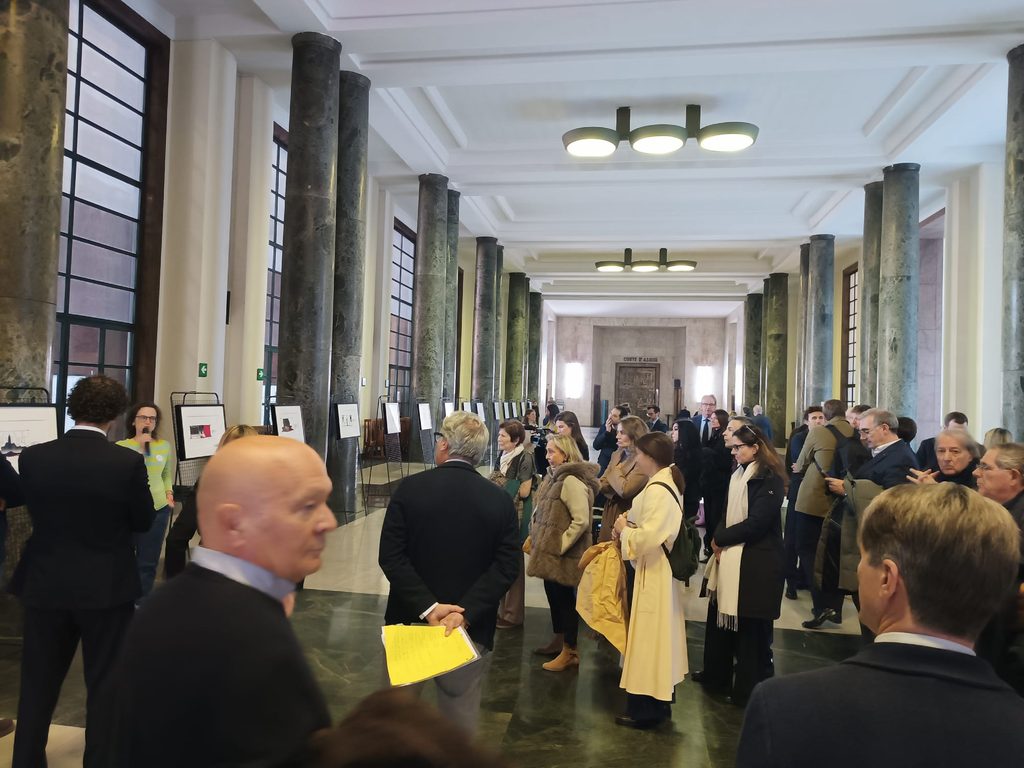
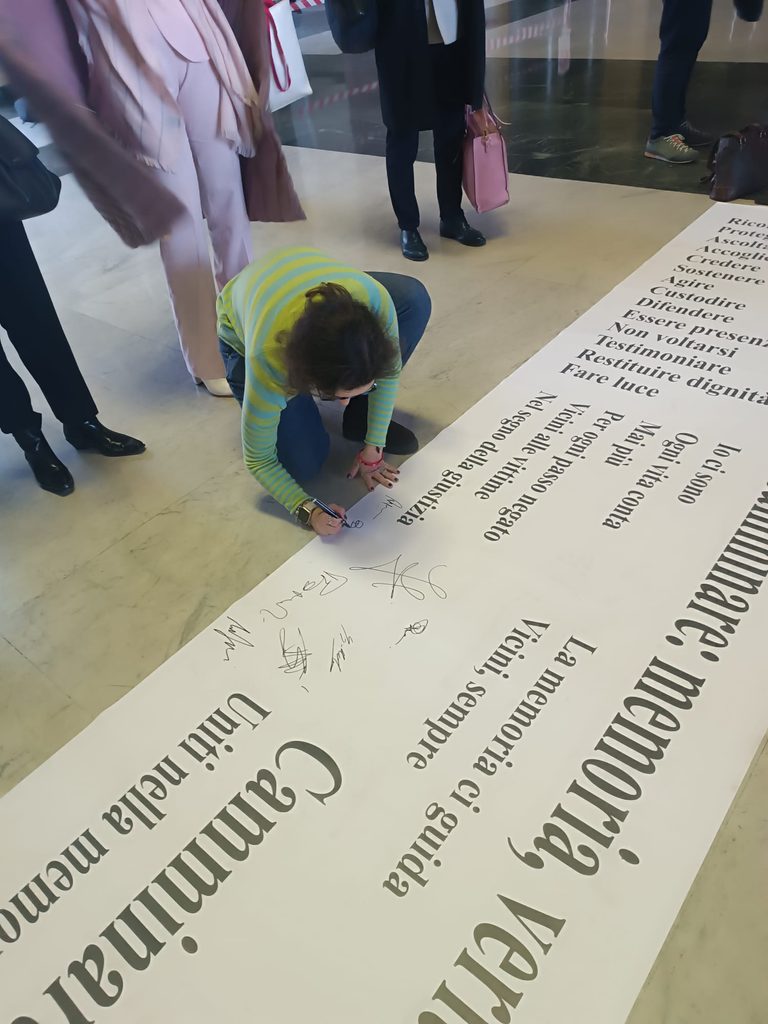
In December 2025, on the occasion of the In the Footsteps of Violence exhibition at the Palace of Justice in Milan, Sergio Brambillasca introduced a new element into the exhibition: a large canvas on which visitors were invited to leave their signatures.
It was the first time this participatory gesture had been introduced within the project.
The canvas was not simply a visitors’ register. It became part of the artistic experience, a space in which every visitor could leave a tangible trace of their encounter with the fourteen artworks.
The signatures bore witness to the presence of the visitors, their participation and their desire to contribute to the memory of the victims.
Through this gesture, the public no longer merely observed: they symbolically entered the artistic journey.
The signatures did not alter the authorship of the fourteen artworks, which belongs entirely to Sergio Brambillasca, but added a participatory dimension to the exhibition.
The canvas thus preserved the memory of those who had passed through that space.
It was an expression of the artist’s language: the artwork originates from an individual vision, but its meaning can continue to develop through encounters with others.
Reality enters the artwork. Art returns it as a question.
9 APRIL 2026 — THE HALL OF MEMORY
The eleventh anniversary of the shooting at the Palace of Justice in Milan, which took place on 9 April 2015, marked another significant moment in Sergio Brambillasca’s artistic journey.
On 9 April 2026, during the commemoration of the victims, Sergio Brambillasca’s artwork Negligence Executed Three Men symbolically transformed Courtroom 2 of the Palace of Justice in Milan into the Hall of Memory.
Through his artistic language, Brambillasca helped give that space a new identity: no longer merely a courtroom, but a place where art preserves the memory of the victims and questions the responsibilities of institutions.
Negligence Executed Three Men.
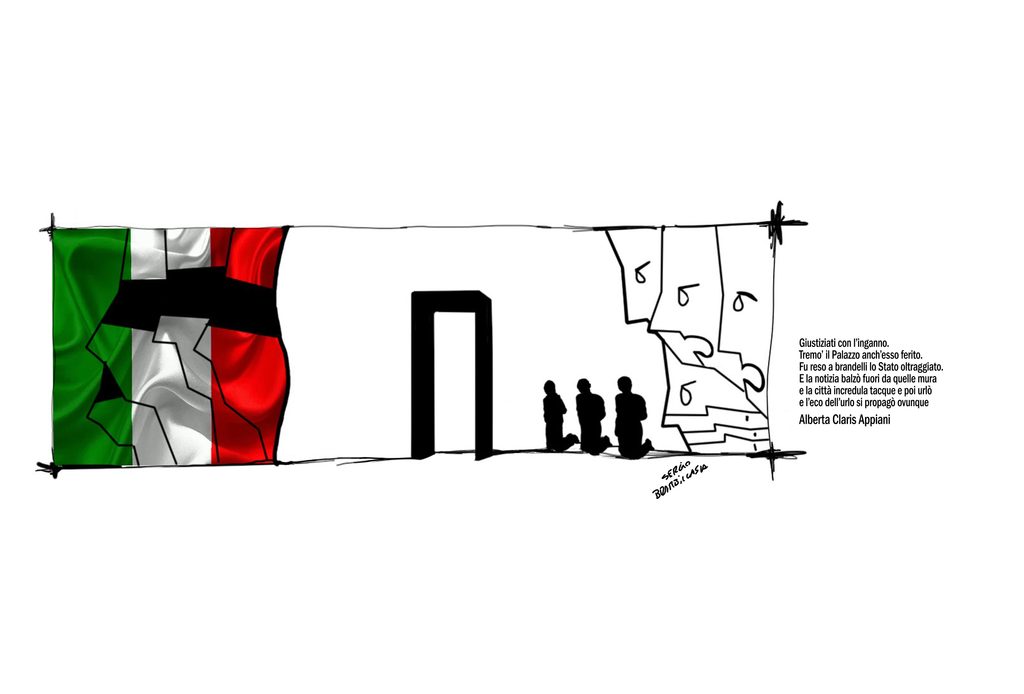
The artwork belongs to the In the Footsteps of Violence collection and is dedicated to the three people killed in the shooting.
The composition does not merely depict the tragedy. Through Brambillasca’s artistic language, it addresses the question of responsibility and the failure of institutions to provide protection when it was most needed.
At the centre stands a black gateway.
It is not an ordinary doorway: it represents the metal detector through which Claudio Giardiello passed without anyone managing to stop him.
The three kneeling figures represent the people who were killed.
The artist portrays them in this position because they had no means of defending themselves.
The word executed in the title emphasises precisely this condition of absolute vulnerability.
The Italian flag represents the institutions and their responsibility.
The black band, appearing within the Italian tricolour and across the eyes of the profiles facing outwards, symbolises the blindness of the institutions.
Those profiles do not look towards the theatre of the tragedy: they are blindfolded and turn their gaze elsewhere, at the very moment when they should have seen, intervened and protected.
On the opposite side, the profiles cry out in pain at the consequences of that negligence.
The artwork thus constructs a contrast between the blindness of those who should have been vigilant and the suffering of those who endured the consequences.
The gateway, the kneeling figures, the flag and the profiles are not decorative elements. Each contributes to the construction of the artwork’s meaning.
The perimeter encloses the theatre of the tragedy, while the artistic language transforms a real event into a question about responsibility.
The artwork does not merely commemorate three people who were killed. It questions what should have protected them and failed to do so.
This is the negligence to which Sergio Brambillasca gives meaning through the title.
The composition is accompanied by words written by Alberta Claris Appiani.
An authorised and authenticated reproduction of the original artwork, approved by Sergio Brambillasca, has been installed in the Hall of Memory.
The original remains part of the collection owned exclusively by the artist, so that the fourteen artworks can continue to be presented together in future exhibitions.
This decision allows the image to remain present in the place of remembrance without disrupting the unity of the collection.
The unveiling ceremony was documented in a video report by alanews, recording the speeches associated with the commemoration and the presentation of the artwork.
Art thus enters an institutional space and helps keep its memory alive.
THE PEOPLE WITHIN THE ARTWORK
Looking back over the history of In the Footsteps of Violence, one constant element emerges.
People are not simply the subjects of the artworks.
They become part of the journey through their testimonies, emotions, encounters and the actions that arise after observing them.
Michele Ruffini’s mother, who, at the first exhibition at Palazzo Pirelli, expressed her gratitude because her son would be remembered.
The girl in Pavia who cried in front of the artwork about bullying.
The teacher who embraced her.
The students in Magenta who transformed Brambillasca’s artistic language into new images.
The young people in Portoferraio who encountered the memory of Lorenzo Claris Appiani.
Alberta Claris Appiani, who wished to bring the exhibition to the place where her son had lost his life.
Simone and Gabriele, who worked alongside their father to install the exhibition at the Palace of Justice.
These are different experiences, but they are united by the same idea: an artwork can continue to live through the people it encounters.
The artist creates the artworks, but cannot foresee every question and emotion that will arise before them.
It is precisely through this relationship that the work acquires further meaning.
THE PAST IS THE SCHOOL OF AN UNWRITTEN FUTURE
In the Footsteps of Violence was born from the desire to transform real events into artworks capable of questioning those who observe them.
The fourteen artworks are the result of Sergio Brambillasca’s research and artistic language.
The testimonies encountered along the journey do not determine their artistic authorship, but broaden their human dimension.
Art cannot erase violence.
It cannot restore lost lives or eliminate the suffering of families.
It can, however, create a space in which that suffering can be heard and memory can find new people willing to preserve it.
The project travels through cities, schools and institutions, but above all it moves through human experiences.
The fourteen artworks remain the starting point.
What develops around them demonstrates that the journey can continue even beyond the artist’s presence.
It is in this sense that one of the central statements of Sergio Brambillasca’s artistic research takes on its full significance:
“The past is the school of an unwritten future.”
The past cannot be changed.
But the future also depends on what we choose to remember.
Sergio Brambillasca